


Only 34% of sustainability leaders report emissions from purchased goods and services, even though it is the largest Scope 3 category for most sectors.
The factory floor gets most of the attention through energy audits, solar panels, and efficiency retrofits. But for most electronics manufacturers, the biggest lever for cutting carbon isn't inside the building. It's in the sourcing decisions made before a single component reaches the production line.
Component Sense is a sustainable electronic components marketplace helping Tier 1 OEMs and EMS manufacturers redistribute excess and obsolete (E&O) inventory as a lower carbon alternative to sourcing new components, directly addressing the purchased goods and services driving most Scope 3 emissions.
What are Scope 3 Emissions?
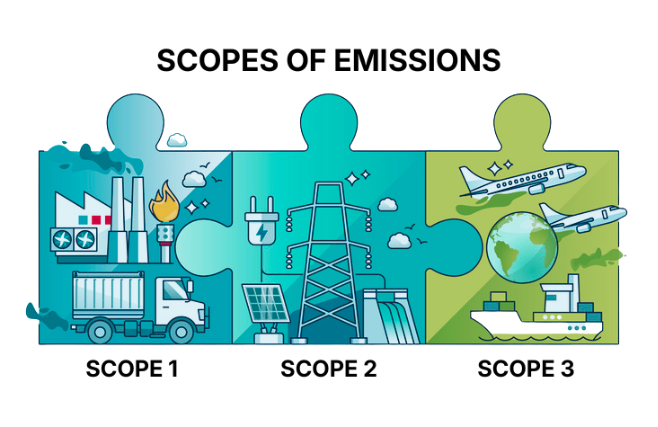
The Greenhouse Gas (GHG) Protocol splits corporate emissions into three categories. Scope 1 covers direct emissions from sources a company owns or controls, such as on-site fuel combustion. Scope 2 covers indirect emissions from purchased electricity, heat, or steam. Scope 3 covers everything else, all the indirect emissions that happen up and down a company's value chain, from the extraction of raw materials to the disposal of a product at the end of life.
Scope 1 and 2 Emissions vs. Scope 3
|
Scope |
Covers |
Typical example in electronics |
|
Scope 1 |
Direct emissions from owned sources |
Fuel used in company vehicles or on-site generators |
|
Scope 2 |
Indirect emissions from purchased energy |
Electricity powering a manufacturing facility |
|
Scope 3 |
Indirect emissions across the value chain |
Components purchased, packaging, shipping, product use, disposal |
Scope 1 and 2 emissions sit inside a company's own operations, which makes them easier to measure and act on directly. Scope 3 sits outside that boundary, in decisions made by suppliers, which is exactly why it's harder to shrink and why it dominates the total for most electronics manufacturers.
Scope 3 Emissions Categories in Electronics Sourcing
The GHG Protocol splits Scope 3 into 15 categories, but for a manufacturer buying components, one category dominates the conversation. Category 1, purchased goods and services, is where the emissions from mining raw materials, refining metals, and fabricating chips are counted, and it is consistently the largest single share of a manufacturer's total footprint.
McKinsey's analysis of typical semiconductor fabs found that purchased materials account for roughly 62% of all Scope 3 upstream emissions, with maintenance, spare parts, and capital expenditures accounting for another 22%. Wafers alone account for close to 15% of that upstream total, driven almost entirely by the electricity used to convert raw ore into polysilicon, a dynamic we cover in more depth in our semiconductor industry trends report.
None of this is under a manufacturer's direct control, and that is exactly the problem. Scope 1 and 2 emissions happen inside your own walls. Scope 3 emissions occur inside somebody else's supply chain, several tiers removed, which is what makes them so hard to measure and even harder to influence.
How to Reduce Scope 3 Emissions Through Component Sourcing
Here is the paradox: manufacturers routinely scrap perfectly good, brand-new components as excess and obsolete stock, while elsewhere in the same industry, other manufacturers are placing new orders for materially identical parts, driving fresh extraction and fabrication to meet that demand.
Every component redistributed instead of scrapped is one that does not need to be mined, refined, and fabricated again, and it is one less unit exposed to the compliance and financial risks of improper e-waste handling.
That is the mechanism behind Component Sense's own sustainability data. Redistributing components that already exist avoids up to 25 kg of CO2e per kg of electronic components compared to mining or fabricating virgin materials. Across the 64 million-plus components Component Sense has redistributed to date, that adds up to roughly 3,759 tonnes of CO2e avoided, emissions that never entered anyone's Scope 3 inventory because the components were never remanufactured in the first place.
Scope 3 Emissions in Transportation and Supply Chain Logistics
 Purchased goods are the largest lever, but not the only one. Transportation and distribution, one of the GHG Protocol's other Scope 3 categories, adds up fast across a global, multi-tier electronics supply chain, particularly when air freight is the default. Component Sense offsets the emissions from every parcel shipped, plants two trees for every order through a partnership with One Tree Planted, now totalling more than 20,000 trees planted. We are proud to be a completely net-zero company.
Supplier concentration is worth understanding, too. McKinsey's research found that at a typical fab, six to ten suppliers account for half of all emissions tied to chemicals, wafers, and gases. That means manufacturers do not need visibility into every tier-three supplier to make progress. Engaging the small handful of suppliers responsible for the bulk of the emissions and prioritising those that already disclose their own footprint moves the needle far more than a scattershot approach ever will.

Nearshoring is another lever worth weighing against transportation-related Scope 3 emissions, alongside cost and lead-time considerations.
Scope 3 Emission Reporting Requirements for Manufacturers
Despite the scale of the problem, Scope 3 remains the most overlooked part of most companies' emissions accounting. Of the corporates disclosing to CDP, only 15% have set a Scope 3 target, and companies are more than twice as likely to measure their Scope 1 and 2 emissions as their supply chain footprint. Regulatory frameworks including the EU's Corporate Sustainability Reporting Directive are moving to close that gap, though the exact scope and timeline continue to evolve, so it is worth tracking rather than assuming the current rules are final.
For sustainability and ESG leads, this is where sourcing decisions begin to do double duty. A component sourced through verified redistribution rather than fresh production is not just cheaper insurance against counterfeit risk; it is also a data point that supports whatever Scope 3 disclosure your organisation is working toward. Traceability documentation that satisfies a quality audit is largely the same documentation manufacturers already maintain for RoHS compliance and WEEE reporting, and it doubles as evidence for an emissions audit too.
Component Sense's own experience bears this out. Working with Corning through our InPlant™ solution, Component Sense redistributed more than 2.5 million components between 2022 and 2025, recovering over $1.55 million and generating 74% year-on-year revenue growth in the first year alone, all from stock that would otherwise have been scrapped.
As Bob Siamro of Corning put it, scrapping excess stock was "a last resort due to environmental concerns," and the redistribution route gave Corning both environmental and financial wins, avoiding the need to choose between them.
How to Start Reducing Scope 3 Emissions in Electronics Sourcing
Reducing Scope 3 emissions in electronics sourcing does not require solving the whole supply chain emission issue at once. Start with the suppliers who account for the largest share of your purchased goods emissions, ask what they can already tell you about their own footprint, and look hard at where excess or obsolete stock in your own inventory could be redistributed rather than scrapped or left to depreciate.
Our guide on reducing e-waste through component lifecycle extension covers the practical side of that last point in more depth, and our Ultimate Guide to a Sustainable Supply Chain walks through the full framework, including Scope 1, 2, and 3, for teams building out a broader strategy.
If your organisation is sitting on excess inventory that could be redistributed instead of scrapped, find out how Consignment or InPlant™ could work for you.