


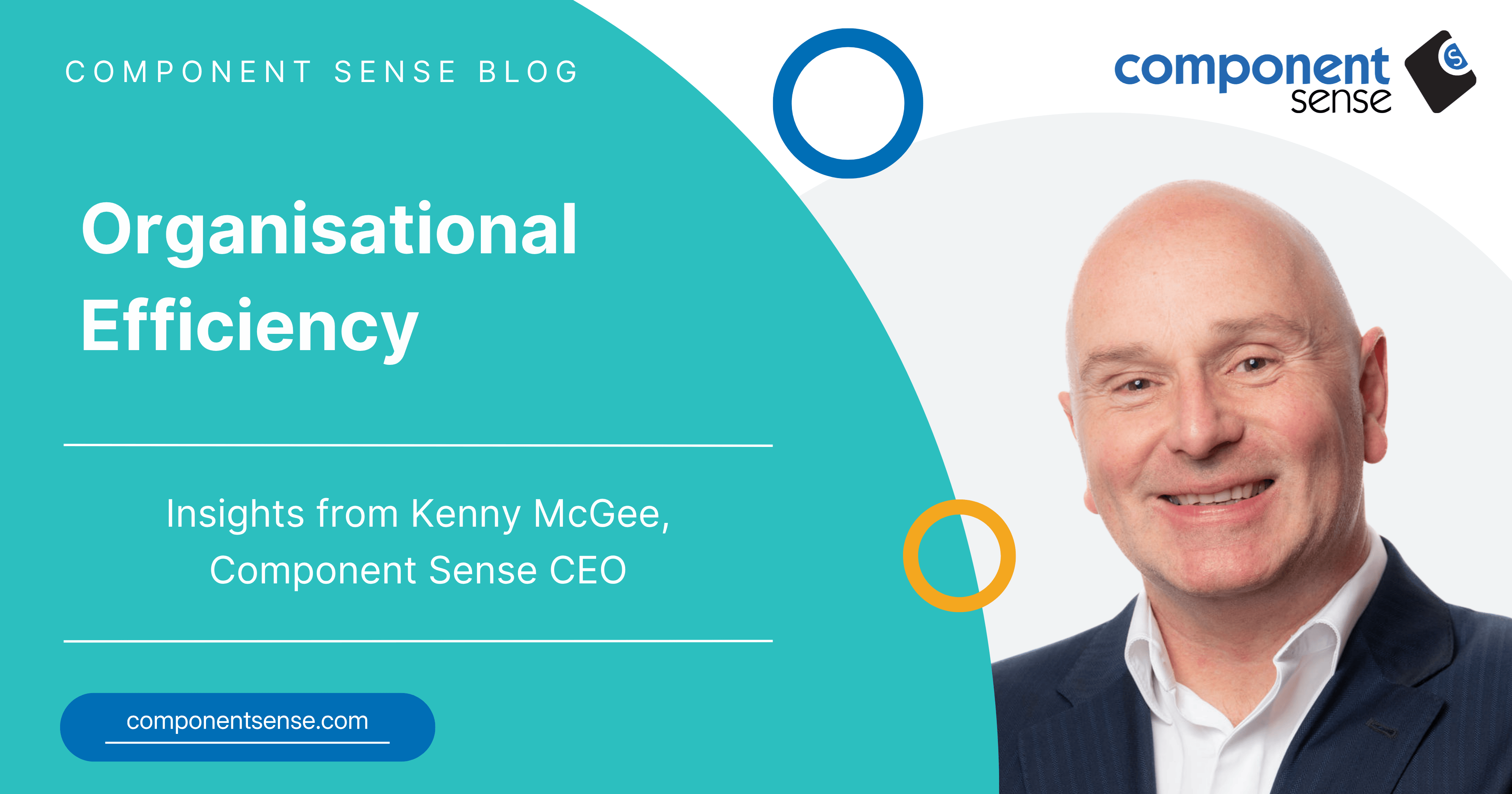
Organisational efficiency is the pillar of a successful business. So, what does organisational efficiency look like for Component Sense?
Component Sense’s CEO, Kenny McGee, views efficiency as foundational; he recalls spotting valuable, unused, and excess stock collecting dust in the corners of factories. For example, an internal audit once revealed £2 million worth of idle components—enough to fill three trucks—sitting unused. He recalls that nothing was happening with that “highly valuable stock.” This stark realisation inspired his mission to eliminate electronic waste (e-waste) and streamline operations.
Kenny’s emphasis on lean thinking and continuous improvement stresses "minimising waste and maximising added value" throughout production. The result is a leadership-led culture where processes are clear, efficient, and designed to deliver quality consistently.
Leadership and Vision Drive Efficiency
Effective leadership sets the vision for efficiency. Research confirms that leaders who set clear goals and champion continuous improvement are key to organisational efficiency. Kenny embodies this principle. He explains that he was brought up to value and look after things, so seeing excess parts “made [him] ask questions.”
He credits his MBA studies in lean manufacturing and Total Quality Management, noting that “operational efficiency was already in [his] blood.” Crucially, he says, “the entire business was created with the goal of reducing and preventing waste.” This personal ethos, combined with disciplined leadership, ensures that the company continually simplifies processes and eliminates non-value-added activities.
Lean Methods and Waste Elimination
Lean manufacturing principles are at the core of Component Sense’s approach. By definition, lean seeks to eliminate waste, or any activity that does not add value, and pursue continuous improvement. In electronics, unnecessary inventory is a major form of waste. Excess or obsolete (E&O) stock ties up working capital and valuable warehouse space. Component Sense tackles this head-on. Our InPlant™ system integrates with the client's MRP to flag true excess at the earliest possible stage. This frees up warehouse space and recovers value, creating more shelf space for higher-value parts. Through such waste-eliminating processes and systems, our company aligns with lean goals: keeping only what is needed and recouping resources wherever possible. 
Technology and Scalable Processes
Technology is the foundation of organisational efficiency at Component Sense. Circa 2010, Kenny invested in building custom software and integrated systems, rather than relying on generic tools. As he notes, “customisation allowed us to strip out any waste, anything that’s not required,” yielding a streamlined, intuitive platform tailored to Component Sense’s workflows. This data-driven system provides real-time visibility into inventory and orders. Smart tracking (for example, Radio Frequency Identification (RFID) tags and automated dashboards) delivers precise data on what’s in stock to avoid overstocking and inefficiency.
Parts that are marked as “in-stock” is the total quantity currently in warehouse, regardless of whether it is available for use or sale. This includes unallocated and allocated stock. “Available” parts are the total quantity that is available for use and sale. It is all current unallocated stock. Component Sense’s live InPlant™ integration ensures components are advertised as actually “in stock” rather than merely “available,” making planning more accurate.
To translate big visions into action, the company also adopted a disciplined planning approach. Kenny implemented the Entrepreneurial Operating System (EOS) framework , as outlined in the book Traction, to break the company’s long-term growth target into three-year, one-year, and quarterly plans. This ensures all teams are aligned: each department now works toward the same quarterly milestones, connecting daily tasks to the overarching strategy. This combination of tailored technology and clear planning enables rapid scaling.

“My head is always in the future and thinking about the big vision, the 10-, 20-, 30-year plan. However, it was much harder for most of our team to see that. By implementing EOS, we were able to break down that plan into quarterly goals that are easier to visualise.”
– Kenny McGee
Quality First and Foremost
Speed and efficiency should never come at the expense of quality.
“Quality comes first... we do not compromise the quality of our operations. Our quality comes first and then efficiency second.”
– Kenny McGee
Quality is crucial, reflecting the critical nature of components that may end up in medical devices or aircraft. Component Sense builds quality into every process, ensuring that once robust controls are in place, processes can safely be accelerated without errors. Structured onboarding and clear standard procedures dramatically cut mistakes and elevate performance. By investing in training and process discipline, we make sure that efficiency improvements enhance, rather than undermine, reliability. In other words, they achieve lean operations on a foundation of uncompromised quality.
Operational Excellence
Looking ahead, Kenny’s vision is true scalability.
“Our systems are solid, they're robust, and they're fantastic for quality, but they’re not as intuitive as I would like them to be yet.”
– Kenny McGee
The goal is to make the system so intuitive and automated that setting up multiple new facilities each week becomes a feasible task. Currently, a new InPlant™ warehouse can be up and running in about a week, but the aim is to cut that time significantly. Kenny emphasises moving towards self-teaching processes, so that new teams can quickly learn the system without lengthy training stints. This forward-looking mindset—constantly refining processes and automating steps—is key to the company’s long-term operational excellence.
By relentlessly improving workflows and technology now, Component Sense is positioning itself to grow globally without bottlenecks, turning efficiency into a strategic advantage.
Key Strategies for Organisational Efficiency
- Set clear goals and metrics. Leaders must define efficiency targets and use data to track progress.
- Adopt lean, waste-free processes. Continuously eliminate non-value steps in workflows.
- Leverage custom technology and data. Utilise tailored systems and real-time tracking to enhance visibility and minimise manual overhead.
- Maintain quality as a priority. Ensure robust quality controls to prevent speed enhancements from introducing defects.
- Empower your people. Train staff thoroughly and encourage feedback – well-supported teams deliver improvements faster.
- Convert waste into value. Use strategies like inventory redistribution (e.g., Component Sense’s InPlant™) to turn excess stock into cash, optimising space and sustainability.
Kenny McGee’s leadership demonstrates that organisational efficiency is holistic, combining vision, lean thinking, technology, and people. With processes that eliminate waste, data-driven systems for visibility, and an unwavering commitment to quality, Component Sense demonstrates how efficiency becomes a competitive advantage. In an era where both agility and reliability matter, this leadership-driven approach delivers clear value in the form of higher output, lower costs, and a smarter, leaner supply chain that’s built to scale.
InPlant™ for OEM and EMS Companies
For OEM and EMS manufacturers, true organisational efficiency begins at the foundational level: the warehouse. With our InPlant™ solution, you can identify true excess and obsolete electronic components at the earliest possible stage to prevent environmental waste. Early visibility into excess can help you avoid costly end-of-life (EOL) surprises, recoup cash value, and free up storage space for active production.
Additionally, InPlant™ works in real-time and can seamlessly integrate into any MRP systems.