



Most electronic components carry a small four-digit stamp that tells you exactly when they were made, the year and the workweek, following a marking convention the Electronic Components Industry Association has published for decades. Read it correctly, and you know a part's true age. Misread it, or fail to notice that it is impossible, and you can let a re-marked counterfeit slip onto your production line.
What is a date code?
A date code records when a component was manufactured, and on most parts, it uses four characters to encode the year and the workweek. It is not a serial number, a batch reference, or a model number, although all of those can sit beside it and look confusingly similar. Its one job is to fix a part in time.
That job matters more than it first appears. The Electronic Components Industry Association runs a standardised date code programme, built on the EIA-476 marking conventions and the MIL-STD-1285 criteria, so that a buyer in one country can read a part made in another and agree on its production date. Age drives moisture-sensitivity handling, solderability, warranty eligibility, and resale value, so a code that looks like background noise on the package is often the single most commercially significant marking on the part.
The standard manufacturing date code format (YYWW)
The standard manufacturing date code format is YYWW, with the first two digits representing the year and the last two the workweek. This is the format you will encounter in many components, and it is the one to try first for any unfamiliar part.
Take 2148. The 21 is the year, 2021, and the 48 is the week, so the part was made in late November 2021.
A few rules keep you honest when you apply them. The week runs from 01 to 52, and very occasionally 53, in the handful of years whose numbering includes a fifty-third week, you will see it only on a part finished right at the turn of the year, around 31 December. Anything reading 00, or a week above 53, is not a valid YYWW date and tells you either that you are reading the wrong field or that something is wrong with the part.
Watch for near-relatives of the format. Some manufacturers reverse the order to WWYY, so 4821 and 2148 can describe the same week. Confirm this by checking that only one reading yields a plausible week and year.
Others use a three-character YWW form with a single-digit year to save space on tiny packages. It is compact but ambiguous across decades. A less common relative, the Julian or ordinal date code, drops the week in favour of the day of the year, usually as YYDDD, so 19200 is the 200th day of 2019, or 19 July 2019.

"In our team’s day-to-day work, 90% of the time we come across electronics manufacturers who use the YYWW format"
Luke McIntosh, Fulfilment Executive
Reading a date code straight from the label
Many parts need no decoder at all, because the date code appears in plain YYWW format on both the box label and the component. When the marking is already four readable digits, you decode it on sight and cross-check the label against the part. The example below is a MACOM-supplied part carrying an AMCC die, and it reads the same way from either side.
.png?width=581&height=340&name=EMS%20Excess%20Graphics%20(13).png)
MACOM S10124PRIB - Label
Start with the label, because it does the work for you. The field is tagged (9D)YYWW, so the format is clearly shown on the print, and the value is 2301, which is week 1 of 2023, or the first days of January. The (4L) country-of-origin field reads TW for Taiwan. There is no ambiguity and no table to consult, because the label states the format and provides the value.
The component tells the same story. The die is marked with the part number S10124PRIB and the date code 2301, the identical YYWW value printed on the box, alongside a Taiwan country mark. Because the part number, the date code, and the origin all agree between the label and the device, you can read the date with confidence and have quietly completed a counterfeit consistency check. This is the everyday case, which is why the four-digit read is always the first one to try.
.png?width=372&height=353&name=EMS%20Excess%20Graphics%20(12).png)
MACOM S10124PRIB – Part
Date code examples from Micron’s manufacturer documentation
If the part above is the easy end of the scale, Micron represents the harder end, where component markings are abbreviated, and you do need the manufacturer's table. A Micron device is a useful part to learn on, because its markings are documented and consistent across most of its products, so one worked example transfers to many parts. Micron prints date information in multiple places, and reading a Micron device end-to-end shows both the easy case and the hard case within a single manufacturer.
On the label and packaging
Micron stays close to the standard. A module label might carry the string 0913, which reads as YYWW, meaning week 13 of 2009. A packaging barcode label spells the same idea out more fully as a six-digit DATE field, for example, 200704, meaning week 4 of 2007. One Micron-specific convention is worth committing to memory: an asterisk at the end of a date code, such as 200404*, means the container holds parts from more than one date, and the date shown on the container label is that of the oldest part inside.
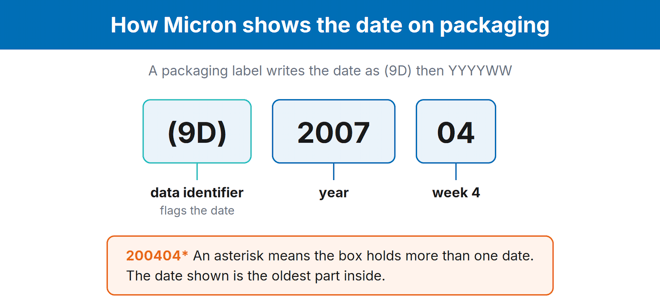
Adapted from Micron
On the component itself
Micron's small FBGA parts run out of room, so they switch to an abbreviated, coded date. Here, the first character is the last digit of the year, and the second character is an alphabetic workweek, using even-numbered weeks only, so A is week 2, H is week 16, N is week 28, and Z is week 52. A part marked with a year digit of 5 and the letter H was made in week 16 of a year ending in 5.
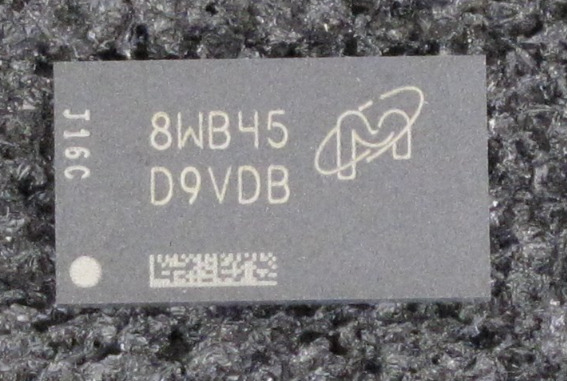
A Micron FBGA DRAM part from Component Sense stock (MT40A512M16JY-083E IT:B). The top line reads 8WB45, so the date code 8W is week 46 of 2018, and the D9VDB beneath it is the FBGA code you decode to the full part number.
Its top line reads 8WB45, and the date code is the first two characters, 8W. The 8 is a year ending in 8. Reading W off the decoder above gives week 46, so the part was marked in mid-November. That single year digit is deliberately terse, so you confirm the decade, 2018 here, from the part generation and your own receiving records. The characters after it, B45, carry the die revision and the country-of-origin codes. The line beneath, D9VDB, is the FBGA code, which you run through Micron's FBGA decoder to recover the full marketing part number. None of that is readable from the part without Micron's documentation, and that is precisely why manufacturer documentation matters.
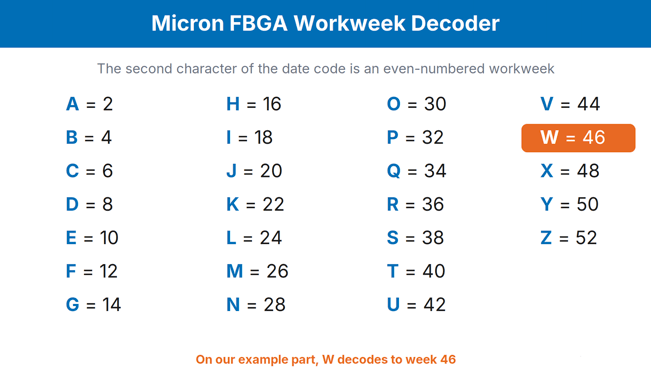
Adapted from Micron
A date code breakdown, step by step
When faced with a Micron device, read the full label date first, treat 200704 as week 4 of 2007, then cross-check the abbreviated code on the part against Micron's workweek table, and finally use the surrounding marks, the country-of-diffusion and country-of-encapsulation digits, to confirm that you are reading a genuine, internally consistent part rather than a re-marked one.
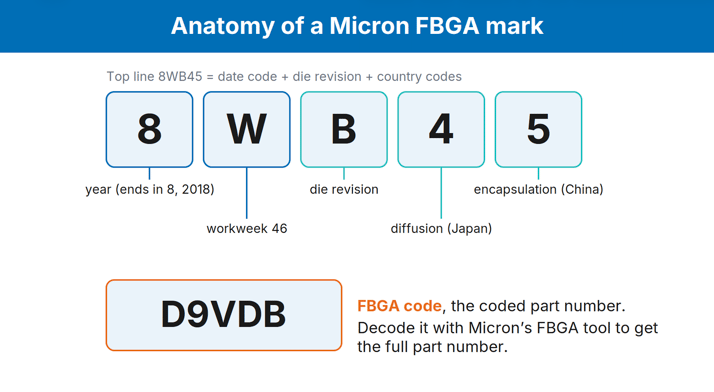
Adapted from Micron
Micron's Customer Service Note CSN-11 sets out these fields in full, and because the scheme is stable, learning it once pays off across most Micron stock you will handle.
When the date code hides inside the lot code
Sometimes there is no tidy standalone date code, and the date is embedded within a longer lot or batch code instead. In these cases, the leading digits of the lot code usually indicate the manufacturing date, which you then convert to the familiar four-digit form. It is the same information, just wrapped in a longer string.
A worked example makes this concrete. If the first six digits of a lot code resolve to 13 May 2022, you convert that to the standard four-digit format by determining the workweek, which gives you 2219, the nineteenth week of 2022.
.png?width=586&height=288&name=EMS%20Excess%20Graphics%20(11).png)
The skill here is spotting which part of a long, run-together code is the date and which is the running batch number. The same checks apply: no week above 53 and no year in the future. If you are also trying to understand how age affects a part you are about to buy or sell, our guide to why shelf life matters in electronics manufacturing picks up where reading the date code leaves off.
How to read date codes when there is no standard
When a part does not use YYWW, you fall back on manufacturer references and physical evidence, because there is no universal system, and some schemes are genuinely unique. A meaningful minority of manufacturers use a single letter for the year, a letter for the month, or their own proprietary table, and a handful keep their decoding scheme private. Reading these markings is a matter of matching them to a source rather than applying a rule.
Several patterns recur often enough to be recognised at a glance. A single alphabetic character sometimes represents the year, cycling through the alphabet each decade. A letter can also represent the month, with a scheme that might run from A for January to a final letter for December, occasionally skipping the letter I to avoid confusion with the numeral one. When the marking gives you a month rather than a week, you often need a second clue, such as the manufacturing or packaging label, to pin down the year with confidence.
That is the honest reality of the job. When a manufacturer publishes a decoder, a difficult code becomes a lookup. When they do not, and the full date code is missing or worn, you triangulate from the date the stock was received and from every other label on the packaging, and you accept that some very old or deliberately obscure parts resist a confident read. This is one of the quieter arguments for full traceability back to the original manufacturer, because a documented chain of custody answers the question that marking alone sometimes cannot.
When a date code signals a counterfeit
An impossible or inconsistent date code is one of the fastest counterfeit warning signs available to a receiving inspector, and it costs nothing to check. The SAE AS6081 standard for counterfeit avoidance exists because a growing volume of fraudulent parts enters the supply chain, most of it when buyers step outside authorised channels. Re-marking is one of the commonest tactics. Fakes are frequently older or lower-grade parts that have been sanded, repainted, and re-stamped with a newer date.
A few checks catch a surprising share of them. A workweek of 00 or above 53 cannot be legitimate. A manufacture date in the future is impossible on its face. A recent date code on a part number discontinued years earlier is a contradiction that should halt the process, and a single tray showing wildly scattered date codes across many unrelated lots is another. None of these is proof on its own, and a clean date code is never a guarantee of authenticity, but an impossible one is a strong signal to quarantine and investigate. For a fuller picture of the risks and controls, see our guide to buying safely on the secondary market.
Why date codes matter for buyers and sellers
For buyers, the date code is a proxy for freshness, and freshness is money. Many OEM and EMS companies will only accept components manufactured within roughly the last two years, because newer date codes solder more reliably and carry less moisture and oxidation risk. When you are looking to buy a hard-to-find or obsolete component, a readable, plausible date code from a traceable source is often the difference between a part you can use and a gamble you cannot.
For sellers, the same logic runs in reverse and against the clock. The newest excess, what we call active excess, carries the freshest date codes and commands the strongest returns, while inventory that sits unrecognised slides towards older date codes and thinner recovery. Identifying and listing excess early, while the date codes are still attractive to buyers, is the single biggest lever in determining how much you get back. Component Sense keeps 150,000-plus lines of traceable components moving to a network of 4,500-plus international buyers, with every part backed by a 12-month warranty and full traceability to its tier-one source.
If you are holding excess whose date codes are only getting older, the best time to act is now. We never cherry-pick; we take the full inventory, and tier-one OEMs and EMS companies trust us to handle it with full traceability. Our Corning case study shows what that looks like in practice, with more than $1.55 million recovered from excess that would otherwise have aged on the shelf.