


.png)
DRAM contract prices jumped 90 to 95% quarter over quarter in the first quarter of 2026, and NAND Flash rose 55 to 60% over the same period, according to TrendForce. Component lead times have followed a similar path. Top-tier semiconductor lead times hit 40 weeks in March 2026, a 67% jump in a single month, and 72% of organisations now say the annual cost of reactive procurement decisions tops $50,000. Procurement teams tracking purchase price variances (PPVs) are absorbing many unfavourable variances in a single budget line this year.
Most conversations about PPV stop at what you paid versus what you planned to pay. But that is only half the story. What about what you recovered when the components you no longer needed left the building? Redistributing or selling excess and obsolete (E&O) stock is a reliable way to offset unfavourable purchase price variance by recovering capital and reducing total net material spend.
What Is Purchase Price Variance?
Purchase price variance (PPV) is the difference between what a company expected to pay for a component and what it actually paid, multiplied by the quantity purchased. It is the standard metric procurement and finance teams use to judge how well buying decisions hold up against the budget.
A favourable PPV occurs when the actual price paid is lower than the budgeted standard cost, generating savings for the business. An unfavourable PPV means the company paid more than planned, a scenario most procurement teams are living through in 2026.
On the redistribution side, the terms work differently. Here, "standard cost" is what a manufacturer originally paid for a component, and "actual" is what it recovers when reselling that component as excess. Recovering more than the original cost is a good outcome; recovering less is a shortfall.
How to Calculate Purchase Price Variance
The calculation requires only three numbers: the standard price you budgeted, the actual price you paid or recovered, and the quantity involved.
Purchase Price Variance Formula
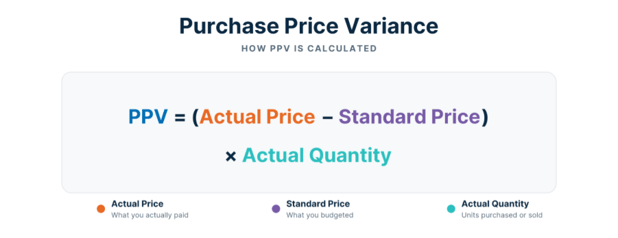
Say an OEM budgeted $18 per unit for a microcontroller based on last year's supply agreement, but the actual invoice price came to $27 per unit for a batch of 50,000 units. That is a PPV of ($27 − $18) × 50,000, or $450,000 unfavourable, driven entirely by market conditions rather than a procurement mistake.
Why Purchase Price Variance Is Under Pressure Right Now
Electronics procurement teams are seeing more unfavourable PPV in 2026 than in recent years, and it is largely structural rather than a sign of weak negotiating. AI data centre demand, mature-node capacity constraints, and geopolitical concentration in chip manufacturing are driving prices up across memory, logic, and interface components simultaneously.
TrendForce's research shows conventional DRAM contract prices rising by 90 to 95% in a single quarter, and tracking of lead times across dozens of component categories found no full recovery since the pandemic-era shortage cycle. When standard costs were set months or years ago in a calmer market, almost every purchase at current pricing shows an unfavourable variance, regardless of how well the sourcing team negotiated.
How to Analyse Purchase Price Variance Data
A single aggregate PPV figure hides more than it reveals. Effective analysis breaks the variance down by category, supplier, and root cause before drawing conclusions about procurement performance.
Start by separating variance driven by market price movement (e.g. inflation, allocation, currency fluctuations) from variance driven by internal decisions (e.g. rush orders, maverick spend, small-batch buying that loses volume discounts). Only the second category is under your procurement team's direct control. It also helps to track PPV alongside inventory age. A component bought at a premium during a shortage but still in active production carries a different risk profile than a component sitting unused because a forecast has changed.
Recognising the Value of E&O in Capital Recovery
Standard cost accounting measures Purchase Price Variance (PPV) as a single event at the point of initial purchase. In practice, however, the ultimate financial performance of a component is determined at its point of disposal: when it is consumed in production, written off as obsolete, or liquidated on the secondary market under recognised asset derecognition standards.
Most manufacturers hold excess electronic components worth roughly 10% of their annual revenue, and very little of that stock is ever revisited with the same financial rigour applied to the original purchase decision.
Our blog post on the excess and obsolete iceberg explains why most inventory teams only see the 1% of E&O that is fully obsolete, missing the 9% (very slow-moving, slow-moving, and active excess) that is still capable of generating strong returns.

That is a missed opportunity. If the standard cost was $18 per unit and the part is now worth $22 per unit on the secondary market because it has become genuinely hard to find, letting it sit in a warehouse or scrapping it converts a potential favourable variance into a sunk cost.
How Redistributing Excess Inventory Offsets Your Unfavourable PPV
Component Sense has redistributed more than 60 million components for manufacturers carrying E&O inventory, and the mechanism is straightforward. Identify the excess early, list it accurately, and get it in front of buyers who need exactly that part.
Three routes exist, and each pushes PPV in a different direction. InPlant™ integrates directly with your MRP system, so E&O is flagged the moment it appears rather than months later. InPlant™ recovers up to 100% of the original cost and, in some cases, generates a genuinely favourable return that helps recover capital lost to unfavourable PPV.
Consignment allows manufacturers to retain ownership while Component Sense uplifts, stores, and markets the inventory as "in stock" to a network of more than 4,500 buyers and brokers. This excess solution model returns up to 70% of the inventory cost.
Outright Purchase suits manufacturers who want cash fast, with a bid within 24 hours and uplift within 48 hours. Outright Purchase is perfect if your priority is clean, quick recovery.
Buyers benefit from the same market too. Sourcing genuine, traceable components through redistribution avoids the unfavourable PPV associated with emergency grey-market purchases at inflated prices.
Turning Unfavourable PPV Into a Recovery Plan
If your PPV report is showing red across the board this year, the honest first question is not "how do we negotiate harder next quarter" but "what is sitting in our warehouse that could be recovering value right now?" Pull an inventory list, flag anything untouched for 6 months or more, and get a same-day valuation rather than waiting for the next fiscal-year-end scramble, when bids typically drop to 5-10% of real value.